Ahrefs DR vs. Semrush AS vs. Moz DA vs. Majestic TF - Domain Authority Metrics Comparison
SEO tools introduced domain authority metrics to measure a site’s backlink profile. Moz launched its
SEO tools introduced domain authority metrics to measure a site’s backlink profile.
Moz launched its DA (Domain Authority) in 2004. Other SEO tools soon followed with their own “authority” metrics.
The goal was to predict a site’s likelihood of ranking in Google Search.
Back then, the plain number of backlinks was the primary ranking factor. Over time, the metrics have evolved. They now include, in varying degrees between the tools, the quality of referring domains, spam factors, and organic traffic.
The market’s four main domain authority metrics are Moz DA, Majestic TF, Ahrefs DR, and Semrush AS.
Here is the quick comparison table:
| Parameter | Moz DA | Majestic TF | Ahrefs DR | Semrush AS |
| Measures backlink strength | ✔ | ✔ | ✔ | ✔ |
| Log (or non-linear) ranking scale | ✔ | ✔ | ✔ | ✔ |
| Factors in Referring domain’s authority | ✔ | ✔ | ✔ | ✔ |
| Accounts for Link juice | ✔ | ✔ | ✔ | ✔ |
| Quality of links and referring domains | ✔ | ✔ | ✔ | ✔ |
| Factors in Organic traffic | ✖ | ✖ | ✖ | ✔ |
| Discover backlinks quickly and in high numbers | ✖ | ✖ | ✔ | ✔ |
| Resistant to manipulation | ✖ | ✖ | ✖ | ✔ |
Let’s examine these parameters and how each tool factors them (or does not factor them) into their domain authority metric.
What Is Common Between These Authority Metrics
Here are the major commonalities between each of these authority metrics:
#1. Measures Backlink Strength
Backlinks are links from other websites pointing to your website. The more backlinks a site has, the more credible it is and the more likely it will rank high on Google.
Authority metrics measure the total strength of a site’s backlinks. If you count backlinks as “votes,” authority metrics measure the site’s “popularity.”
Over time, SEO tools have moved on from measuring the raw quantity of links to a more nuanced approach.
Authority metrics now factor in the quality of links, link juice, authority of the referring domain, and more – which we will discuss shortly. However, the crux of the metric still revolves around a site’s backlink strength.
#2. Rank Websites on a Log (or non-linear) Scale
All the authority metrics rank sites on a logarithmic or a non-linear scale of 0 to 100, with the latter being the highest.
The higher the number, the higher the backlink strength.
Semrush and Ahrefs explicitly state that the sites are plotted logarithmically. Whereas Majestic admits it is non-linear.
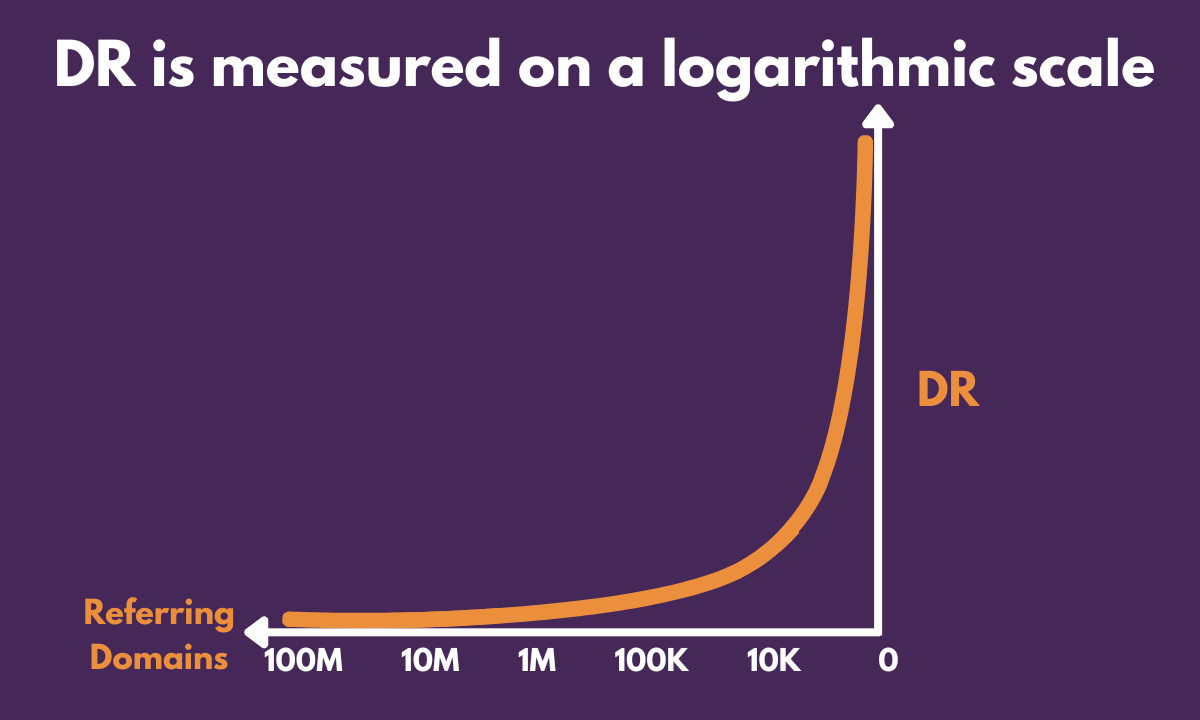
This means that increasing the authority score gets more challenging as you move to a higher score. For example, increasing from an authority score of 1 to 3 is far easier than improving an authority score of 71 to a score of 73.
That’s why hundreds of millions of sites have an authority score of less than 10 for all these tools, and only a handful have a score near 100.
#3. Factors in Authority of the Referring Domain
No authority metric simply counts the number of backlinks and referring domains to a website.
Different links have different weights.
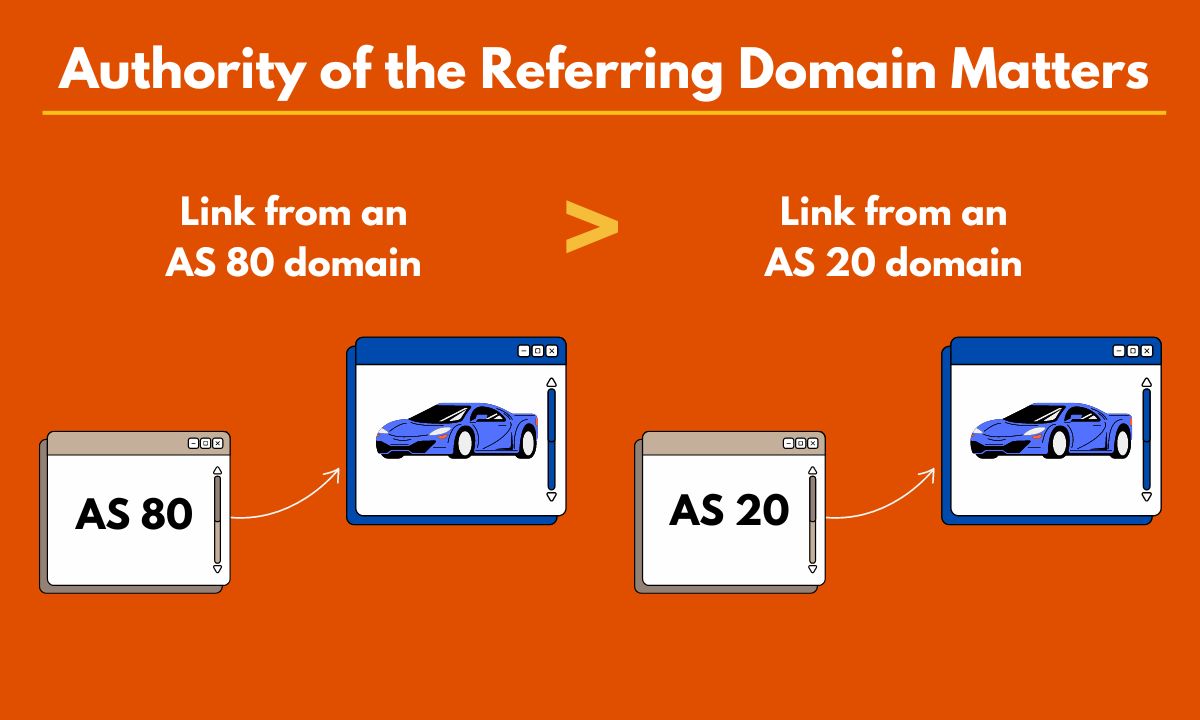
A link from a high-authority site, such as one with an authority score of 80, carries more weight than one with an authority score of 20.
#4. Accounts for Link “Juice”
Link juice is the value or authority the referring domain passes on to a site with its link.
And link juice matters in all these domain authority metrics.
A site linking out to more sites will pass less juice than a similar authority site linking out to fewer sites.
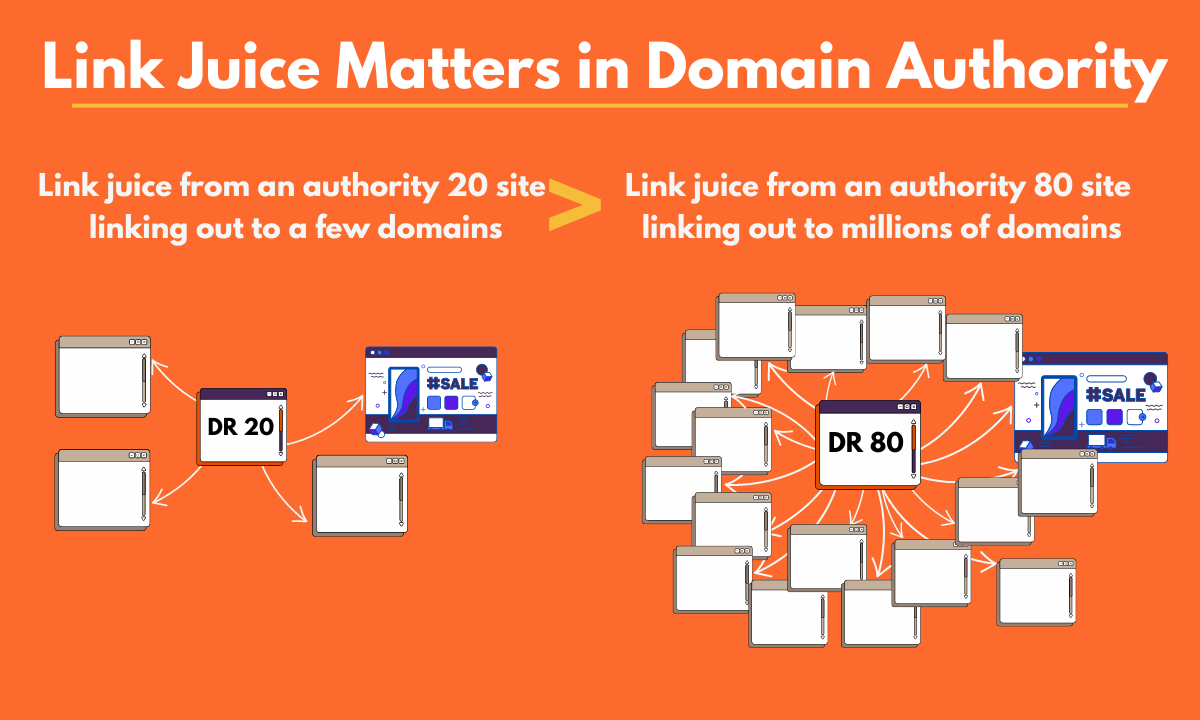
Another way to look at it is – an authority 20 site linking to only ten domains will pass on more link juice than an authority 80 site linking to millions of domains.
#5. Quality of Links
All the authority metrics claim to account for quality links and spam signals now.
Authority metrics have become a target for manipulation. SEO tools recognize this fact and have tried to curb these link spamming efforts.
Semrush states it looks for spam factors like:
- No organic rankings on SERPs
- An unnaturally high % of do-follow domains
- An imbalance between links and organic traffic
- Too many referring domains with the same IP address
- Too many referring domains with the same IP network
- The presence of another domain with an identical backlink profile
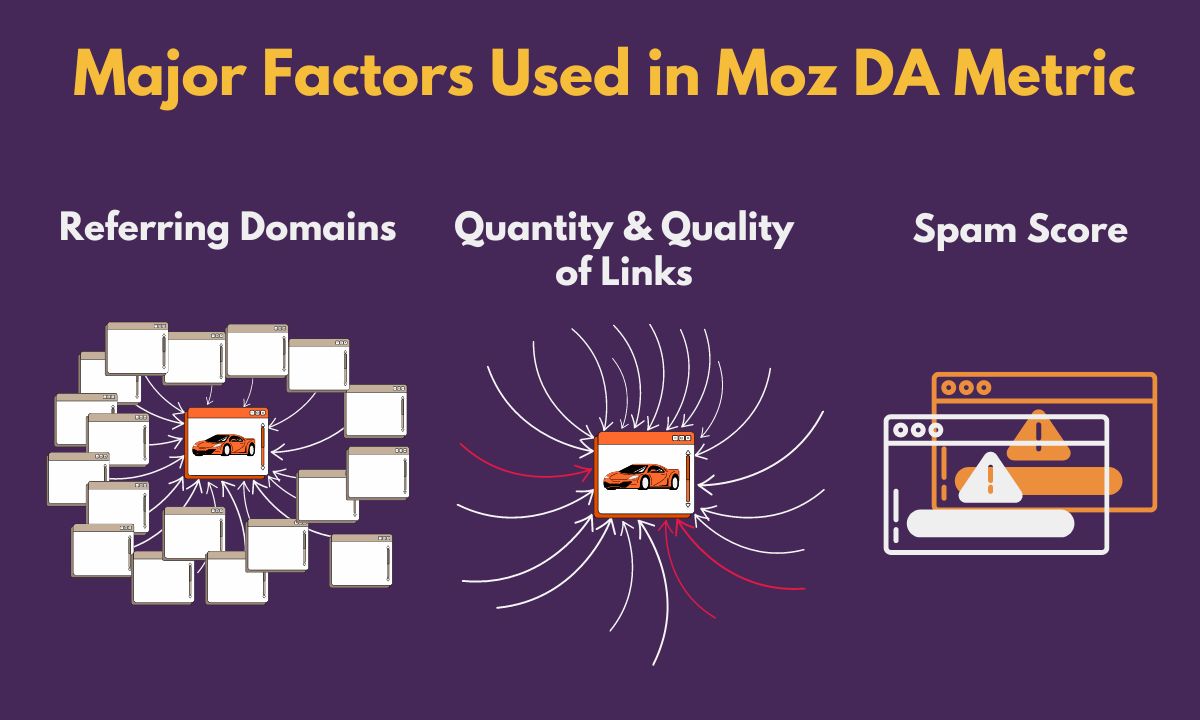
Moz, in its documentation, says it updated its DA calculation methodology to account for quality since 2019. DA now incorporates multiple factors to measure link quality and spam score to assess DA.
Majestic claims to consider links only from quality and reputed sites in its TF calculation. In contrast, its CF metric calculates raw backlink strength.
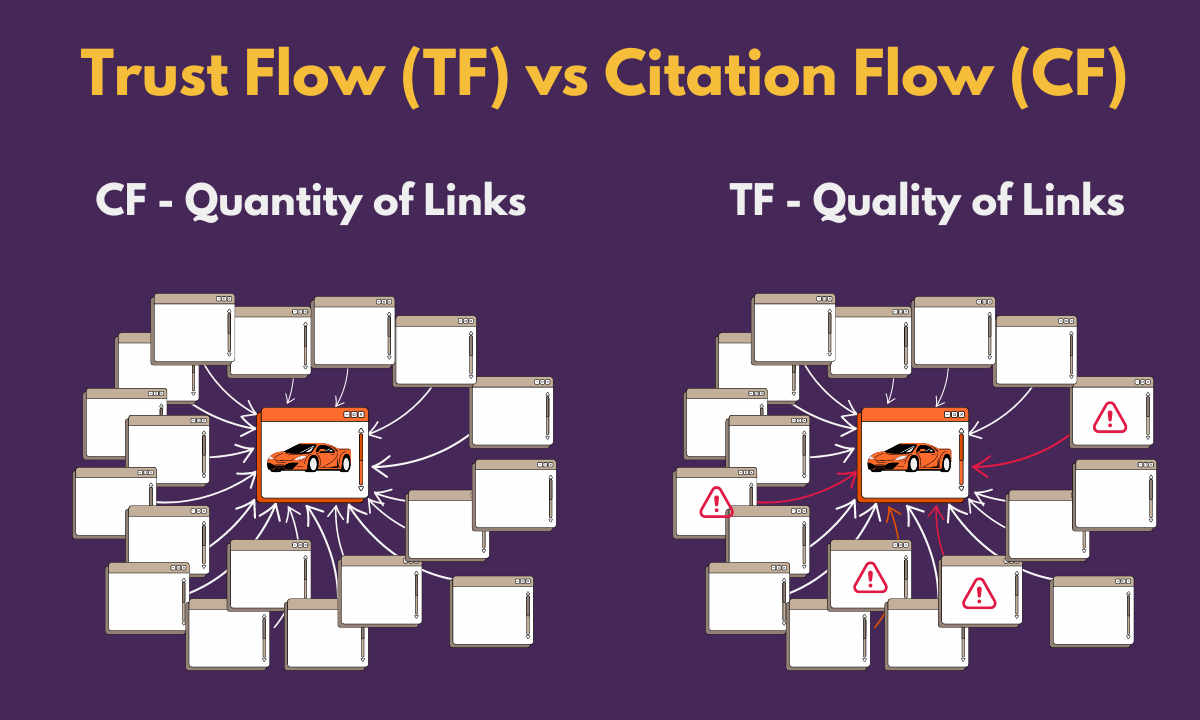
Ahrefs, too, says that its DR accounts for both the quantity and quality of links.
Overall, all authority metrics now consider the quality of links a more vital factor than raw backlink counting.
Are these claims real? Yes and no. Based on our recent experiments …. I will discuss manipulation in a minute.
What Are the Differences?
Here are the key differences:
#6. Organic Traffic
So far, the factors have all focused on links. Whether it’s the link authority, link juice, or quality of the referring domains, it’s still about links.
Organic traffic is a non-link metric. And not all tools factor it into their authority score calculation.
However:
Without factoring in organic traffic, authority metrics can be highly manipulative. Authority only matters with relevancy and significant rankings on Google in the site’s relevant niche. A site with an 80 “authority” score but with zero traffic in its relevant niche can never be authoritative.
If authority metrics don’t include or reflect a site’s organic traffic, then they are – (a) manipulative; and (b) don’t reflect real authority.
By factoring in organic traffic, the authority metric provides a more “complete” picture of a site’s standing in front of Google’s eyes.
Still, none of these authority metrics – Moz DA, Ahrefs DR, Majestic TF – factor in a site’s organic traffic.
Semrush AS is the only metric that accounts for a site’s organic traffic and the balance between links and traffic.
This helps Semrush to weed out any authority manipulation, which we will discuss shortly.
#7. Discovering backlinks
Domain authority calculation does not factor in ALL the backlinks. No SEO tool, not even Google, discovers all backlinks.
But you want SEO tools to discover a good number of links to reflect reality. How actual and up-to-date the backlinks discovery is matters greatly in the authority metric calculation.
If the SEO tool is slow and does not discover links for weeks or months, then the authority metric does not reflect reality and has no practical use in tracking a site’s progress.
So:
We conducted several experiments to check how often these SEO tools discover backlinks. Semrush and Ahrefs discovered far more referring domains than Moz and Majestic.
We ran another study on backlinks discovery between Ahrefs and Semrush. Both tools discovered different numbers of referring domains for the same sites. But Semrush discovered far more referring domains than Ahrefs and for far more sites.
What does this have to do with domain authority metrics though?
The more backlinks discovered, the better the domain authority calculation gets. More discovery means more “information” about the site.
So, while no tool discovers ALL the backlinks, Semrush seems to discover the most backlinks to factor in their AS calculation. Followed by Ahrefs.
#8. Resistant to manipulation
Most Domain “Authority” metrics are not tamper-proof.
There is an industry of freelancers ready to inflate site authority metrics using link spam.

We researched how these authority metrics can be manipulated. Here is the detailed research.
The simplified version is – we hired five freelancers to inflate authority metrics for five domains. We paid these “authority hackers” from $15 to $80 – $275 for five contractors.
Only one domain (DRvsASExperiment.com) was paid to manipulate all metrics, and the rest were paid to manipulate only the Ahrefs DR.
We then waited for two months.
Here are the results:
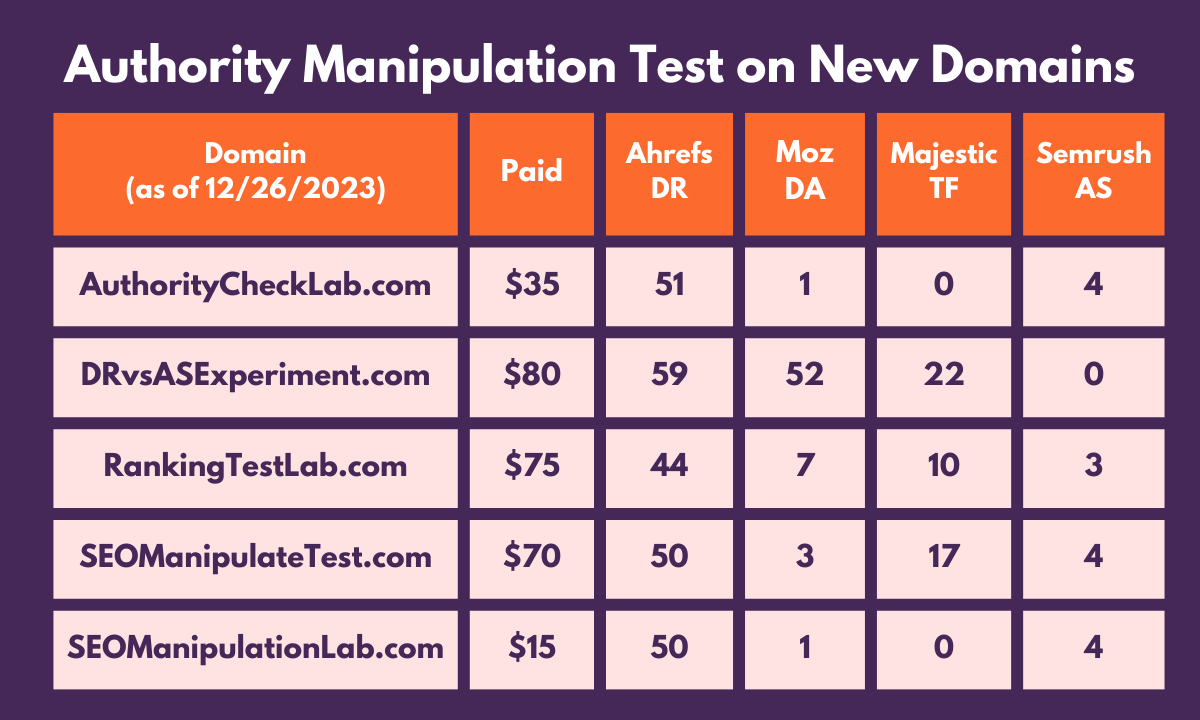
Key takeaways:
- Ahrefs DR is the easiest to manipulate out of all the authority metrics.
- While Moz DA and Majestic TF are not as easily manipulated as Ahrefs DR, they still can be manipulated by the right “Authority hacker.” (Check Moz DA)
- Semrush is the most reliable and tamper-proof authority metric. The AS cannot be inflated easily. (Check Semrush AS)
All the domains have no content, zero traffic, and rank for zero keywords. Yet, the authority metrics show different scores. Except for Semrush AS, these authority metrics can be unreliable if the site links get manipulated.
Which Is the Best Authority Metric?
Any authority metric, like Moz DA, Majestic TF, Ahrefs DR, or Semrush AS, can track your website’s progress or compare unmanipulated sites.
If you’re unsure about a domain’s authenticity or want a more reliable and complex approach, use Semrush AS.
Three reasons why:
- Semrush AS is the only metric that factors in organic traffic, along with the quality of the links and spam factors, in their AS calculation. Providing a more “complete” picture of a site’s standing in Google’s eyes.
- Semrush discovers more backlinks to a site (research) and discovers it the fastest (our research).
- Semrush AS is the most tamper-proof domain authority metric (our research).
Max Roslyakov
Founder, Xamsor