How to Write an Article
Starting to write is hard. The good news is that writing itself is a trainable
Starting to write is hard. The good news is that writing itself is a trainable skill.
And content published with 3 out of 10 quality checkmarks is infinitely better than perfect content you never posted. It’s just math.
In this post, I’ll share the simplest way to create written content. To make it work long-term, you should update and improve your articles. But to begin with, you just need an OKay-ish result.
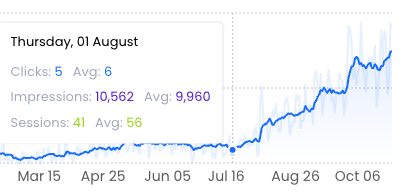
We started using this approach three months ago when Google sent only five visitors to my website daily. Today, the average is 52. The key change? We simplified our approach to writing.
Screenshot from Content Audit Tool
Let me share how we do it at Xamsor.
#1. Decide who you are writing to.
My favorite tactic for writing a blog post is to pretend I’m writing to someone who asked me to explain the topic.
Larger businesses often use buyer personas or customer avatars and tailor their content to one of these predefined personas.
However, keep it simple for smaller businesses or when you’re just starting—describe who you’re writing for in a few words.
Here’s an example from the article I’m writing in another tab:
“My audience – the guest-posting marketplace owners and independent link-builders.”
From there, remember that you are explaining a specific topic to this person. The rest is to tick a few checkboxes.
#2. Find the topic
Once you have the buyer persona, picking the topic gets easier. You know the pain points, the topics they are interested in, and the topics they want to know more about.
The standard SEO advice is to start with “Strategy”, conduct ‘Keyword Research,’ check the ‘search volume,’ and find the ‘relevant keywords’ to include.
While this process has merits, it’s also longer and more complicated. I find it easier to brainstorm a few ideas, pick a topic, and just write.
In addition, writing about one topic often gives me ideas for other content. That’s where my topics come from.
So, I dive into the content and then think about its SEO aspects later.
#3. Write the ugly draft
Once I have a topic in mind, my brain wants to say a lot about the topic. But the thoughts are still unstructured—and that’s okay.
Let me proceed with the wrong approach before the right one.
I have realized that the worst approach is to—analyze, try to outline, create a flow, focus on style and grammar, and overall try to create a perfect piece.
What happens is that I get stuck in analysis-paralysis mode and end up not writing much or not writing at all. The need for perfection brings out the procrastinator in me.
Rather, the best approach is:
To write. Just write.
We call it the “vomit stage”. I write whatever thoughts I have in mind about the topic into the paper. It won’t be perfect, and I am okay with that.
I pay no attention to grammar, spelling errors, flow, structure, outline, images—nothing.
It’s called an “ugly draft” for a reason. So, put your thoughts into the paper, you can figure out the rest later.
#4. Give it some time
Once the draft is ready, take a break.
Ideally, there should be enough time between the first draft and the edit to decompress and gain a fresh perspective.
I usually try to give an hour or half-hour break to get some distance—a good time for a coffee break or lunch.
#5. Edit the article
Now, I start the editing process. This is where grammar, style, flow—everything comes into the picture.
I use Grammarly to fix spelling and sentence structure errors. Editing also helps me notice some of the ideas I have written in the first draft that need more clarity or explanation and sometimes need to be cut down.
I also add transitions, subheadings, paragraph breaks, and sometimes rejig the content to make the article well-structured.
Sometimes, I add images and screenshots to make the article more visual and helpful. But it’s not mandatory and not something I always stick with.
The goal is to edit the content and turn the ugly first draft into a readable and valuable article. Once I feel the article is fair (not perfect!), I hit the publish button.
#6. Publish the article
There’s no such thing as a perfect article. If I let perfectionism take over, I’d never publish anything—or I’d post only once a month, struggling each day just to start, make progress, and finish.
So, once I have edited the article, I publish it. Does that mean the article is great?
Not yet. But the idea is to put the “Minimum Viable Content” out there.
#7. Want to run the extra mile? Work on the intro.
The first paragraph prompts the reader to decide if they’ll go beyond the first few lines. You have only five seconds to make a connection or lose your visitor, which is why intros are so important.
Since you’re reading this far, we likely wrote a good one. I used the PPP framework for this intro, where PPP stands for “Problem, Promise, Proof.”
Here’s how it works:
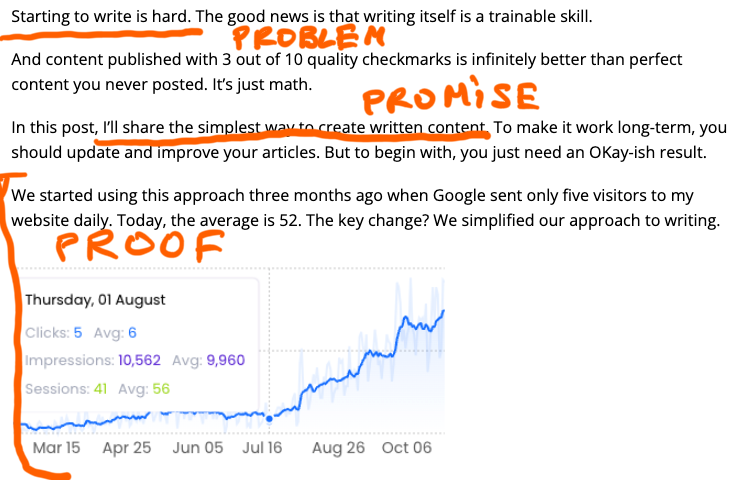
I stated the problem – the assumption of why you are here. Promised to deliver a solution. And explained, why my opinion matters. Very simple yet powerful approach to start your content.
#8. Revisit the article after a few months. Or days…
Published articles are great. Publishing gives satisfaction. Even if you feel moderate shame about the result, it’s OK. A little shame will motivate you to learn and update the content to make it better.
From a technical perspective, published content provides data and insights on what and where to improve.
So, for now, publish that article first. You can always come back and update it later.
Is there anything missing in this article? Feel free to join the discussion on LinkedIn.
Want to get notifications about the new posts? Subscribe to the e-mail newsletter.
Max Roslyakov
Founder, Xamsor