Majestic TF (Trust Flow) Explained
Trust Flow (TF) is a metric developed by Majestic to measure the quality of a
Trust Flow (TF) is a metric developed by Majestic to measure the quality of a site’s backlink profile.
Majestic also has a companion metric called Citation Flow (CF), which factors in only the quantity of links.
TF goes beyond CF. It accounts for links from trusted and reputed sites and disregards links from spammy and low-grade sites.
So, let’s dive into Majestic’s TF metric, how the algorithm calculates it, how it differs from CF, and whether it’s easy to manipulate this score.
What Is the Majestic TF (Trust Flow)?
Majestic TF is an SEO metric measuring the quality of a website’s backlink profile.
In Majestic’s own words:
“Trust Flow is our headline metric. It is a score between 0-100 that models the quality of links pointing to a URL or domain. Trust Flow aims to reward high-quality links from authority sites.”
The higher the TF, the higher the site’s quality of backlinks.
You can check a site’s Majestic TF for free from here.

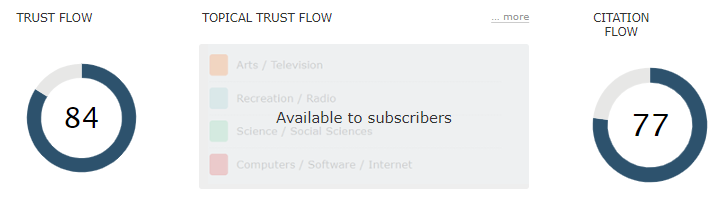
You will get the site’s Trust Flow (TF) and the Citation Flow (CF) – which we will discuss next.
TF is measured on a non-linear scale. Increasing TF from TF 10 to TF 12 is far easier than improving from TF 80 to TF 82. Improving TF gets more challenging as you move to a higher score.
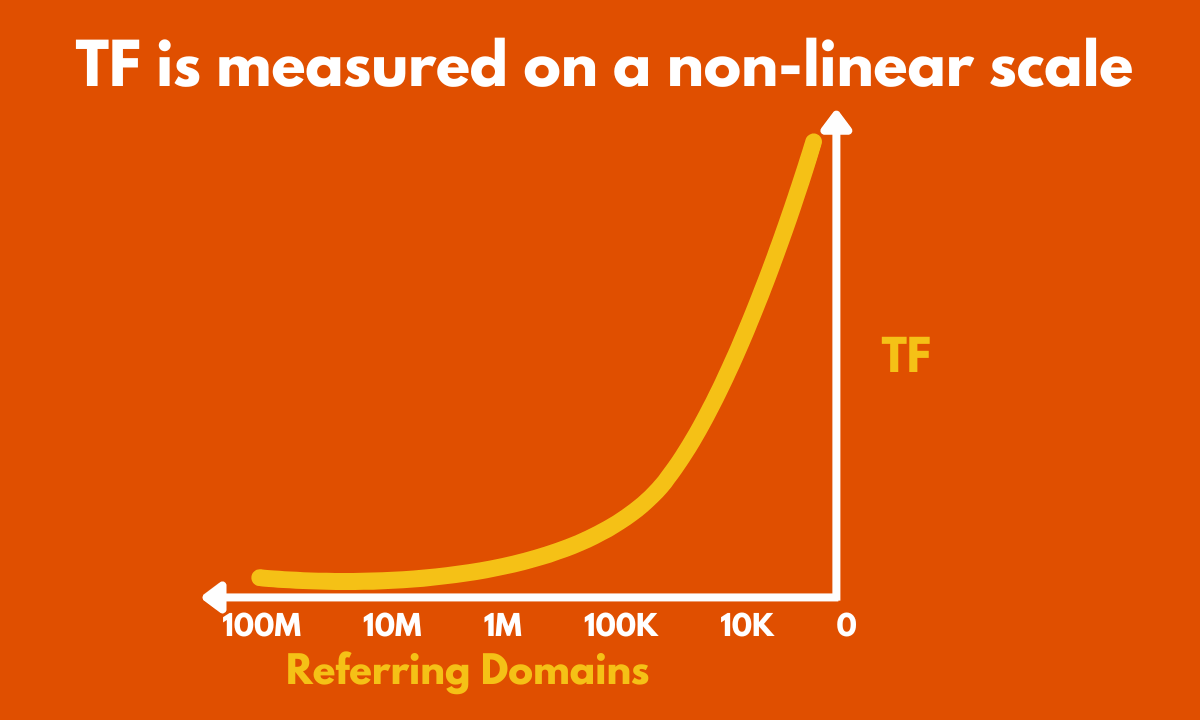
That’s why hundreds of millions of websites have a TF of below 10, but only a few hundred have a TF near 100.
Trust Flow (TF) vs Citation Flow (CF) – What’s the Difference?
Citation Flow (CF) measures the site’s raw backlink strength.
Unlike Trust Flow, Citation Flow does not factor in the quality of backlinks. It only reflects the number of links to a site.
TF focuses on link quality, whereas CF focuses on quantity.
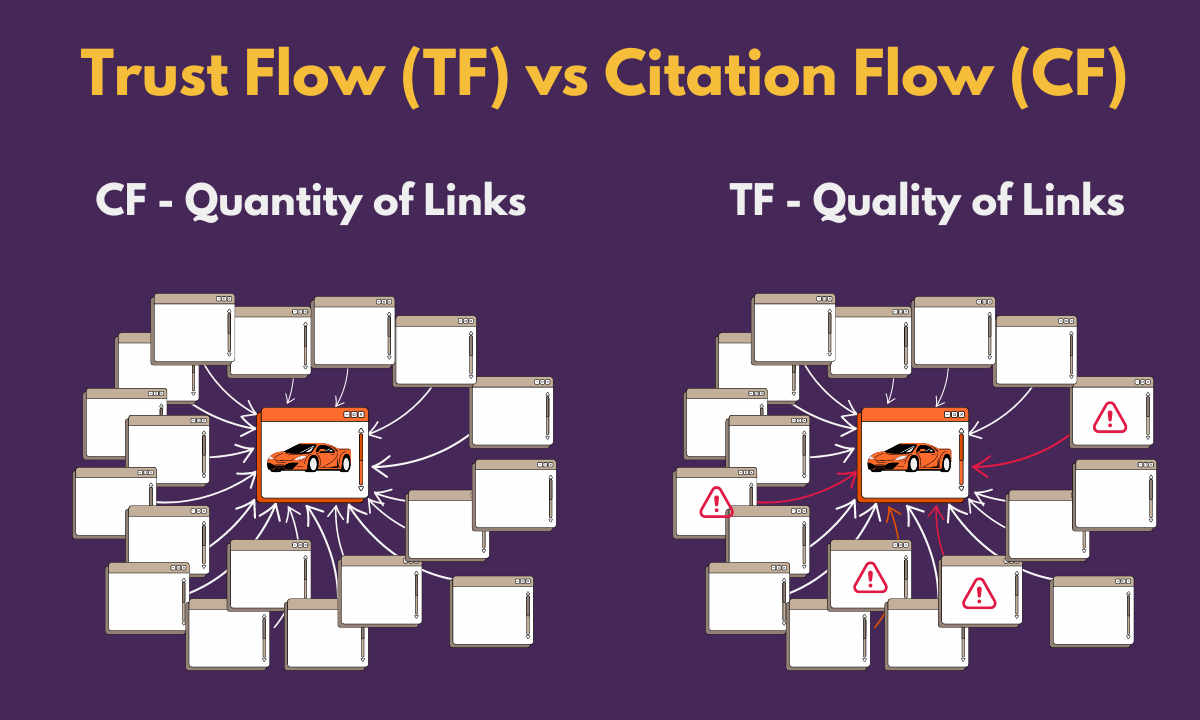
CF does not care whether a link is of good quality or bad quality. It does not differentiate between a spammy link and a good link.
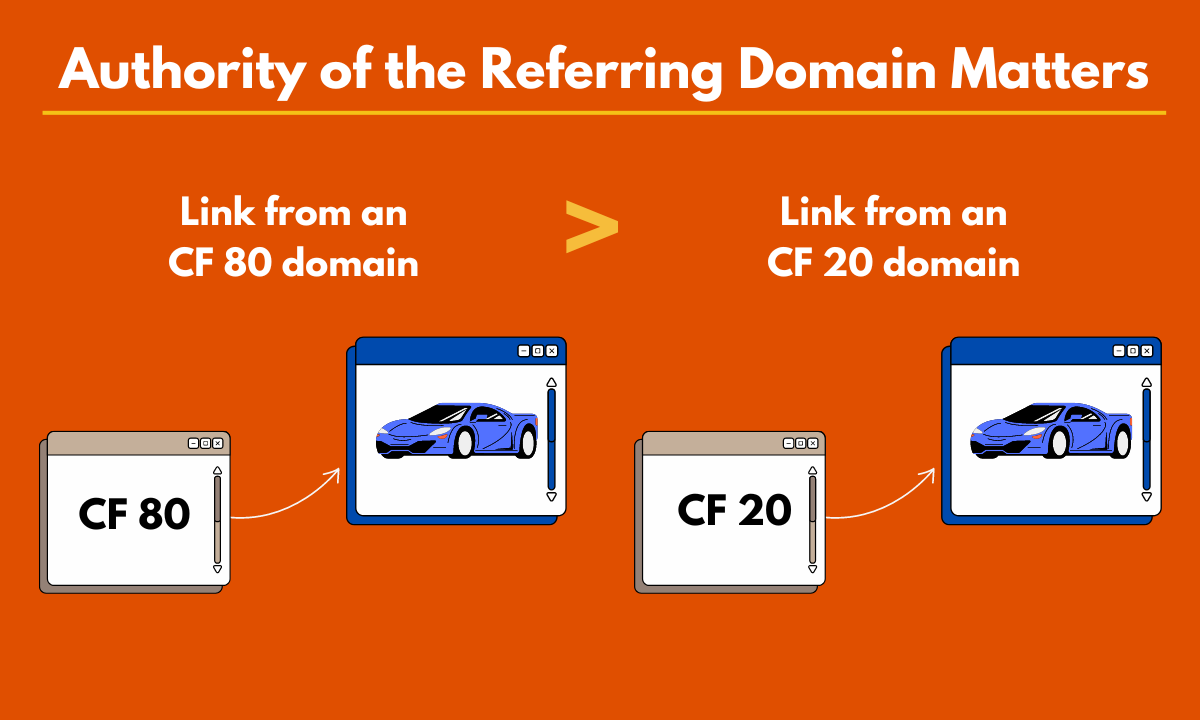
However, CF does account for authority. It doesn’t simply count the number of links. The links have weightage. A link from a high authority site, say a CF 80 site, carries more weight than one from a CF 20 site.
Trust Flow goes one step beyond and accounts for link quality as well. How does it do it? Let’s dive in.
How Is the TF Calculated?
Trust Flow (TF) measures the quality and reputation of a site’s backlinks.
How does it do it?
Majestic has a seed set of sites that they qualify as a high quality and high reputation set. Humans manually review these sites.
From the seed set of human-curated sites, it identifies other quality sites. The algorithm works because the high-quality seed sites are likely referring to other quality sites, which in turn link to more quality sites.

Trust flow scores and ranks the site based on the quality of links it receives.
Sites closely linked to the trusted seed sites get higher TF scores. And the sites with no quality links would see much lower TF scores.
Majestic TF Can Be Manipulated
Citation Flow (CF) is easy to manipulate since it only focuses on the quantity of links. But TF (Trust Flow), which factors in quality, can also be manipulated.
Despite Majestic using only trusted and quality links to calculate the TF score, it can be tampered with.
An industry of freelancers is ready to inflate a website’s authority metric, including Majestic TF.

These freelancers offer to inflate these authority metrics – Ahrefs DR, Moz DA, and Majestic TF. None offered Semrush AS manipulation (we have discussed why Semrush is not easy to manipulate here). Learn more about True Domain Authority.
So here’s what we did:
We contracted five “authority hackers” to inflate the authority metrics of five new domains.
After two months, these were the results from these “authority hackers”:
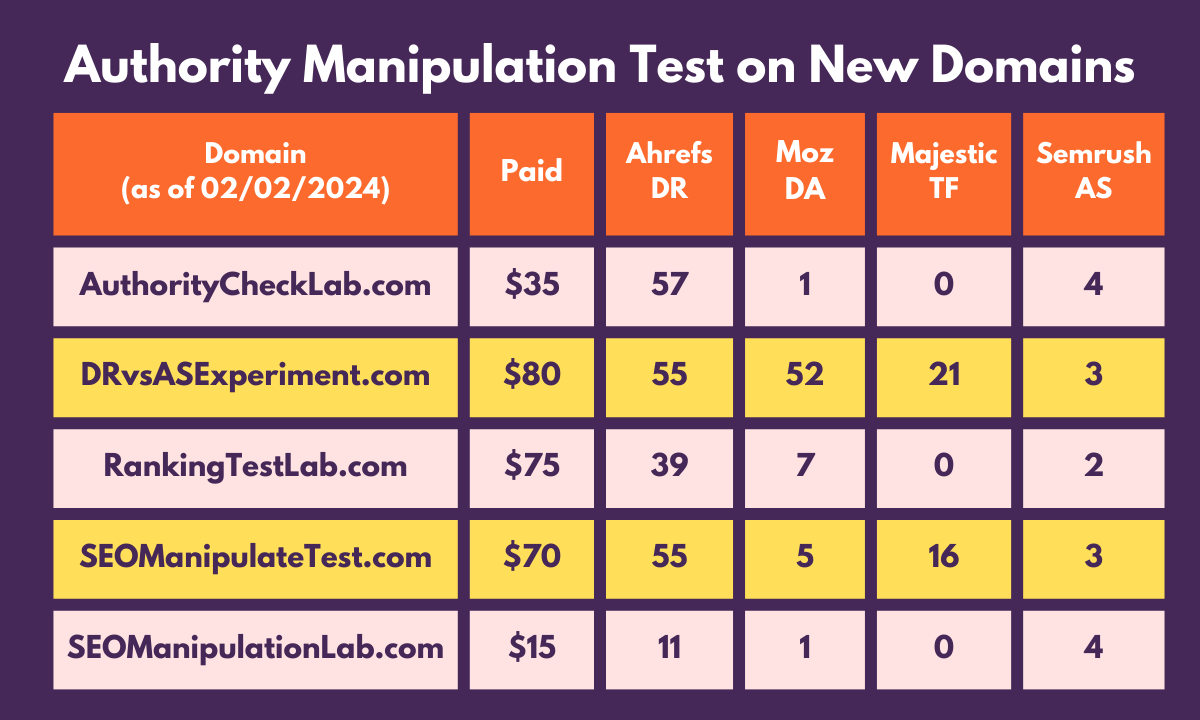
As you can see, while Ahrefs DR is the most easily tampered metric, Majestic TF doesn’t fare well either. Despite TF factoring in only the quality links, they are still susceptible to manipulation.
With the right “Authority hacker,” the majestic TF score can be manipulated. For $150, we did that with two domains—a TF of 21 and a TF of 16.
To their credit, Majestic eventually caught on.
They did recognize, albeit late, the TF manipulation in these domains. As of 8 April 2024, the sites have lost all their TF scores. That’s probably a Majestic team reaction to our published research.
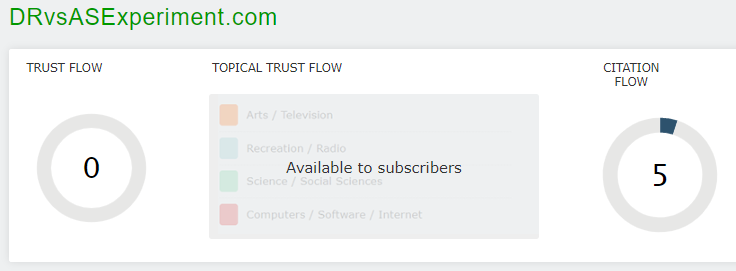
Bottomline. While TF is not completely tamper-proof, it’s more manipulation-resistant than Ahrefs DR and Moz DA. Also, manual checks from the team behind the tool can determine fair “authority” and reset the metric. In our case, the inflated TF score returns to zero after a few months.
What Is a Good TF Score?
A good Trust Flow score is when your site’s TF is higher than your competitor sites, assuming their TFs aren’t manipulated.
TF or CF does not say much in isolation. It’s a vanity metric valid only when compared with other competitor sites.
For example, a site with a TF of 10 might find it tough to rank on Google when most of its competitors’ sites have TFs of more than 50.
Similarly, a TF 20 site might rank easily when all of its competitors have a TF of less than 10.
Again, a high TF does not guarantee high traffic. It can be used as a proxy metric. But not as an absolute metric.
Wrapping Up
Majestic TF does not say much in isolation like any other authority metric. However, it can be helpful when comparing TF scores with competitor sites, assuming TFs aren’t manipulated.
Regarding manipulation, Majestic TF fares better than Ahrefs DR and Moz DA. While it could still be tampered with, the TF score eventually catches up.
Max Roslyakov
Founder, Xamsor