Great selling point or untapped opportunity. How SEO metrics help to sell websites.
My largest acquisition so far was the $5 million purchase of backlinko.com, a content and
My largest acquisition so far was the $5 million purchase of backlinko.com, a content and online learning website.
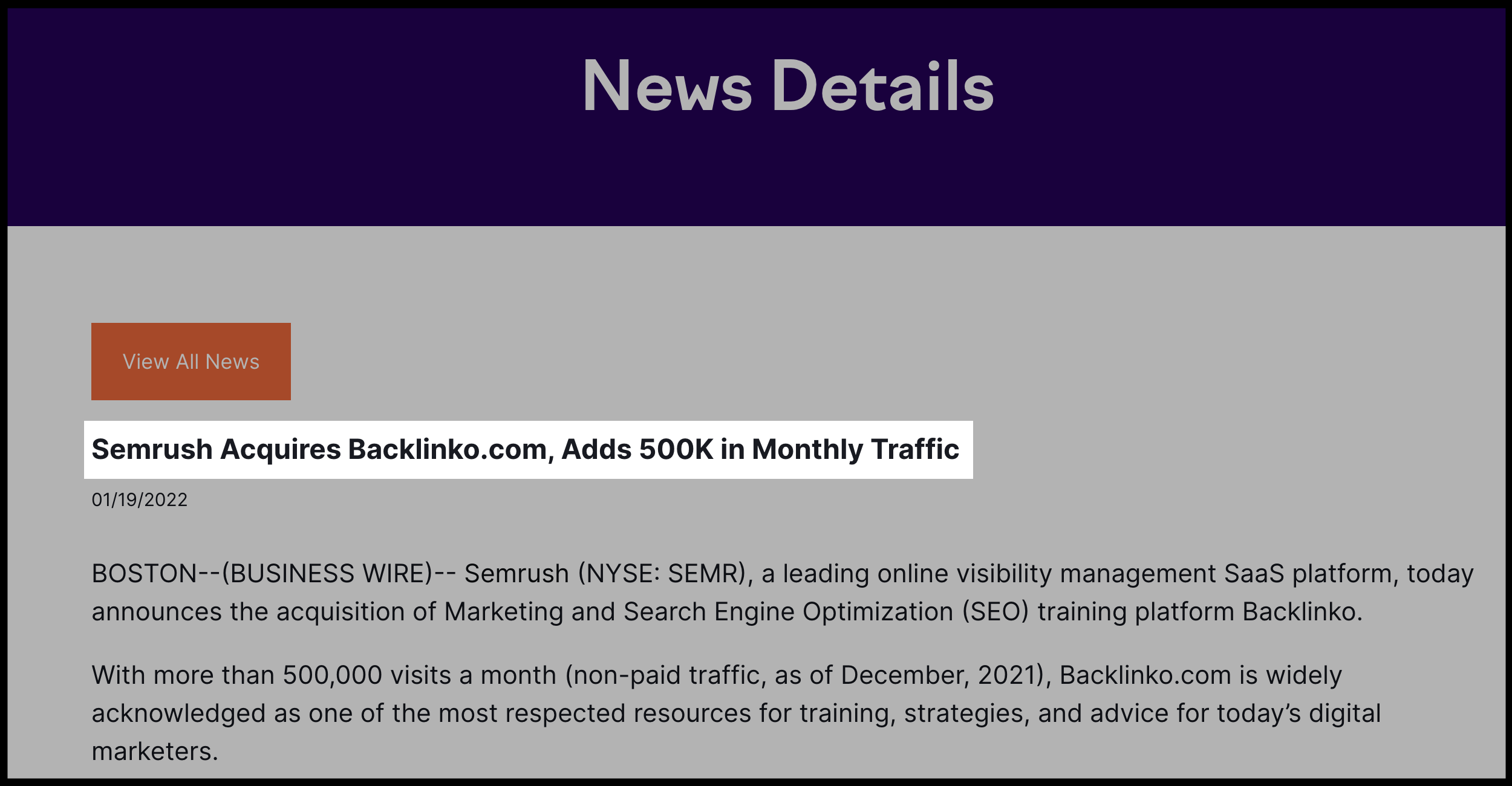
The interesting part of this deal was that the paid content of the acquired asset was made available for free to the general public.
Yes. The paid educational content that generated millions in profits for the previous owner was shared without a paywall on the Semrush Academy.
You may ask, why did the buyer acquire it for then?
The answer is – Backlinko’s extraordinary performance on Google search.
Great SEO Performance Finds Buyers
I was the Senior Vice President of Marketing for Semrush (NYSE: SEMR), the world’s leading SEO and marketing software. My goal was to find ways to hack the company’s growth — to do something above the regular marketing activities to gain some extra growth quickly.
That’s when a content acquisition idea came up.
Backlinko was ranked in Google’s top results for thousands of keywords, fully relevant to the Semrush business of SEO and online marketing software.
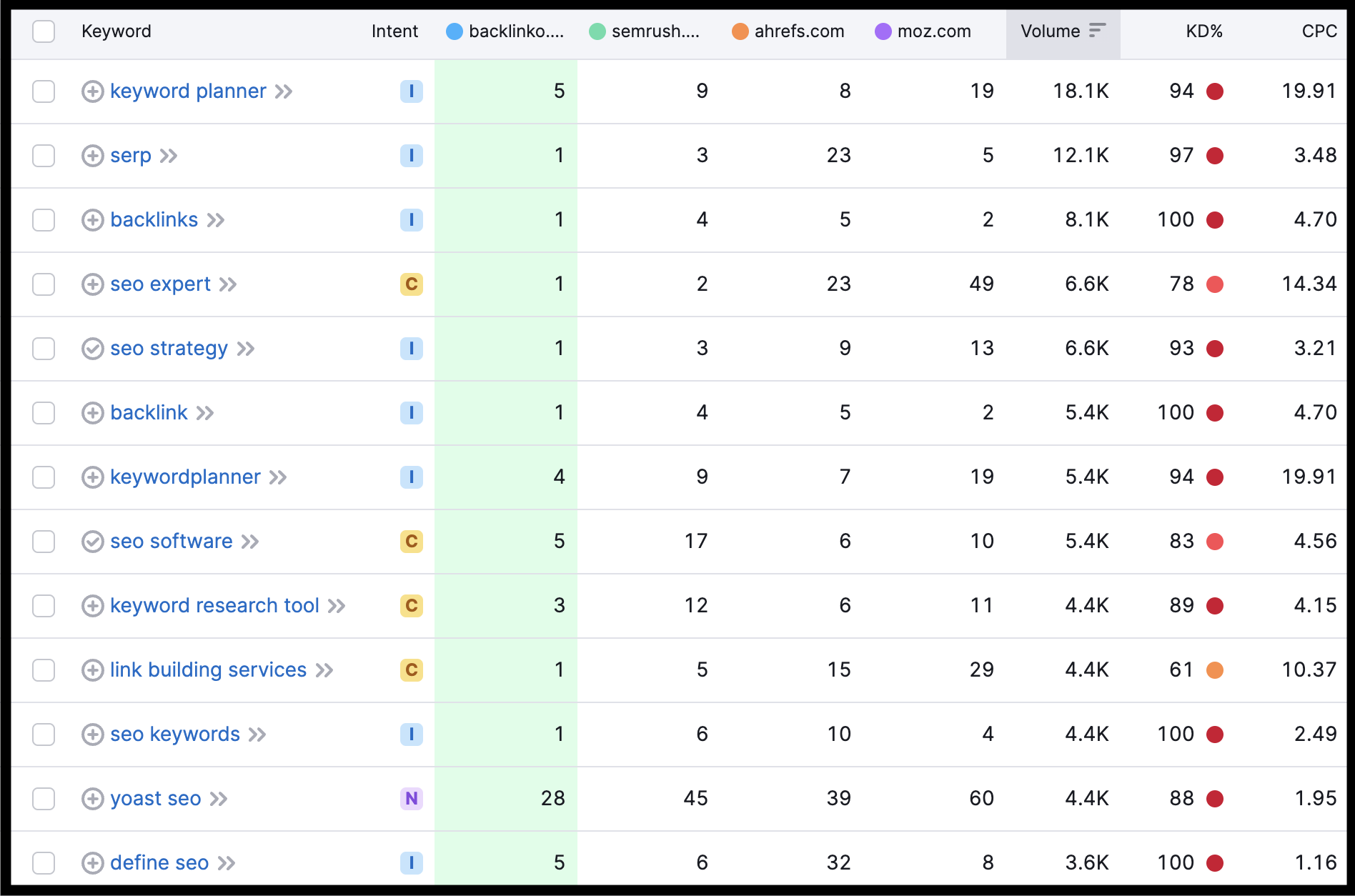
Thanks to the founder’s talent and effort, Backlinko generated over 500k monthly visitors. This surpassed any Semrush competitor, including Ahrefs and Moz—big names in the SEO SaaS space, with valuations of 100+ million dollars.
And Backlinko outranked them for thousands of highly competitive keywords.
With this acquisition, we gained control over the most influential content in the industry. That soon led to an additional revenue stream that paid back all the money and effort invested in the acquisition.
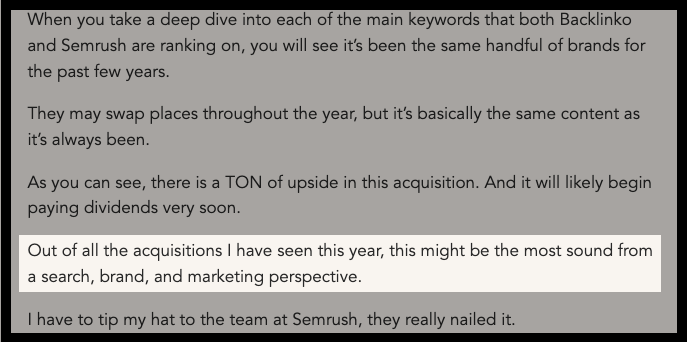
Bottomline. Great SEO performance can be valued at millions of dollars.
Bad SEO performance can also be desirable for the buyer. That may sound weird, but please continue reading, and I will cover this shortly!
For now, I’ll highlight that top online business marketplaces like Flippa and Empire Flippers share SEO performance metrics in their listings.
Because they know it benefits all marketplace users — buyers, sellers, and brokers.
Buyers are making better-informed and data-driven decisions. Gaining more transparency on online marketing performance and future estimates.
Sellers are getting additional points to justify the multiples and highlight the value of the website they are selling.
Brokers help sellers describe their listings in more detail and gain more trust and interest from buyers.
Showing SEO metrics increases interest in the listings and streamlines the decision-making process.
Which metrics are the most important? Let’s cover this.
4 Key SEO Metrics to Quickly Evaluate a Website
There are four primary SEO metrics and one meta-metric to evaluate the website quickly.
#1. Keywords
Keywords are search queries users enter in Google.
The more keywords a website ranks for, the more diversified its organic traffic stream is, and the more opportunities it has to scale up its growth quickly.
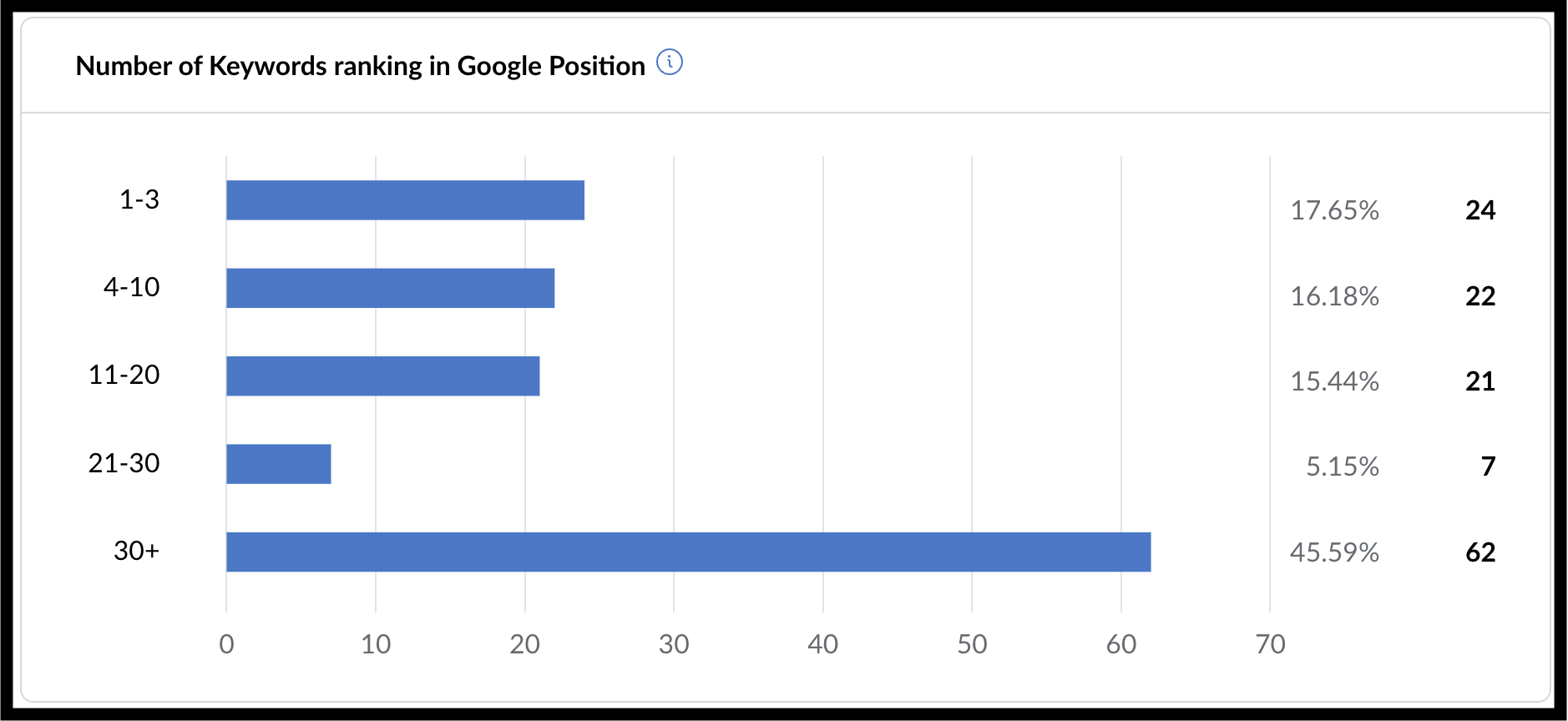
It’s also good to understand the keywords split by ranking in Google:
- Top-3: These are cash cows. More than 50% of Google’s traffic arrives from the first three results. Ranking in Top-3 usually takes 3+ years for a new website, so the number of keywords in Top-3 is a good selling point and indicator of SEO success for any website.
- Top 4-10: These are low-hanging fruits. They are still getting some traffic from Google, but it could be better. Improving the content already ranking this high can increase rankings, moving the page into the “cash cow” category.
- Beyond Top-10: While pages ranked below 10th in Google rarely generate feasible traffic, they represent the website’s general authority on the business niche and provide opportunities to grow further.
#2. Organic Traffic
This one is easy. It’s how much traffic the ranking keywords bring from Google to the website.
More is better. The only nuance is that keywords should have obvious business intent and be relevant to the website niche.
Relevant organic traffic is like passive income. It brings new business without effort and will be handed over to a new owner.
As for the traffic trends, there are few patterns to recognize. (You can check website organic traffic here.)
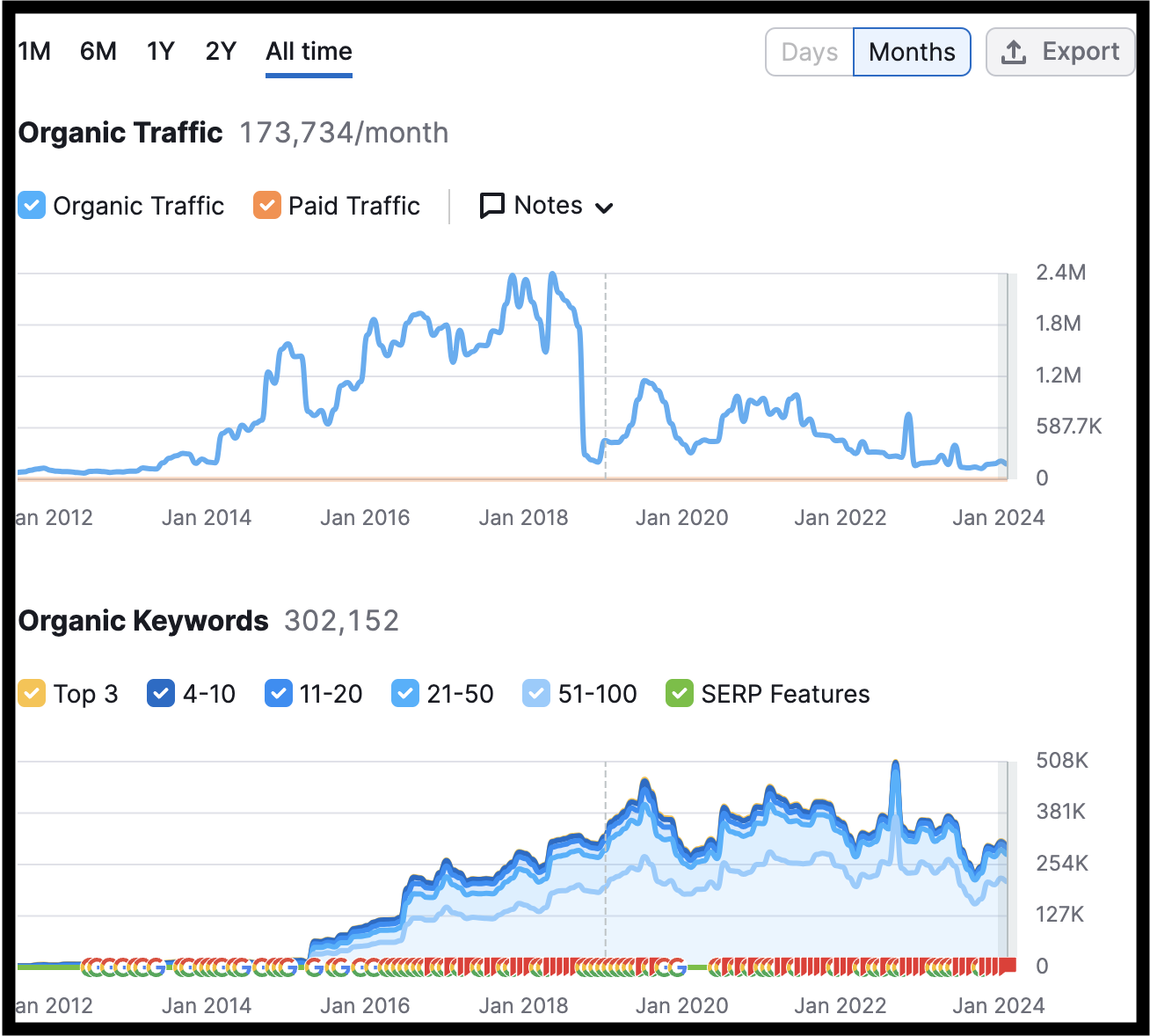
- Stable performance: The website’s traffic is stable over the years, without drops or spikes lasting longer than 2-3 months. The growing trend is more desired. The declining trend usually reflects a lack of content updates and the need for new content production. It’s fixable, though, so a declining trend in general is not a big deal.
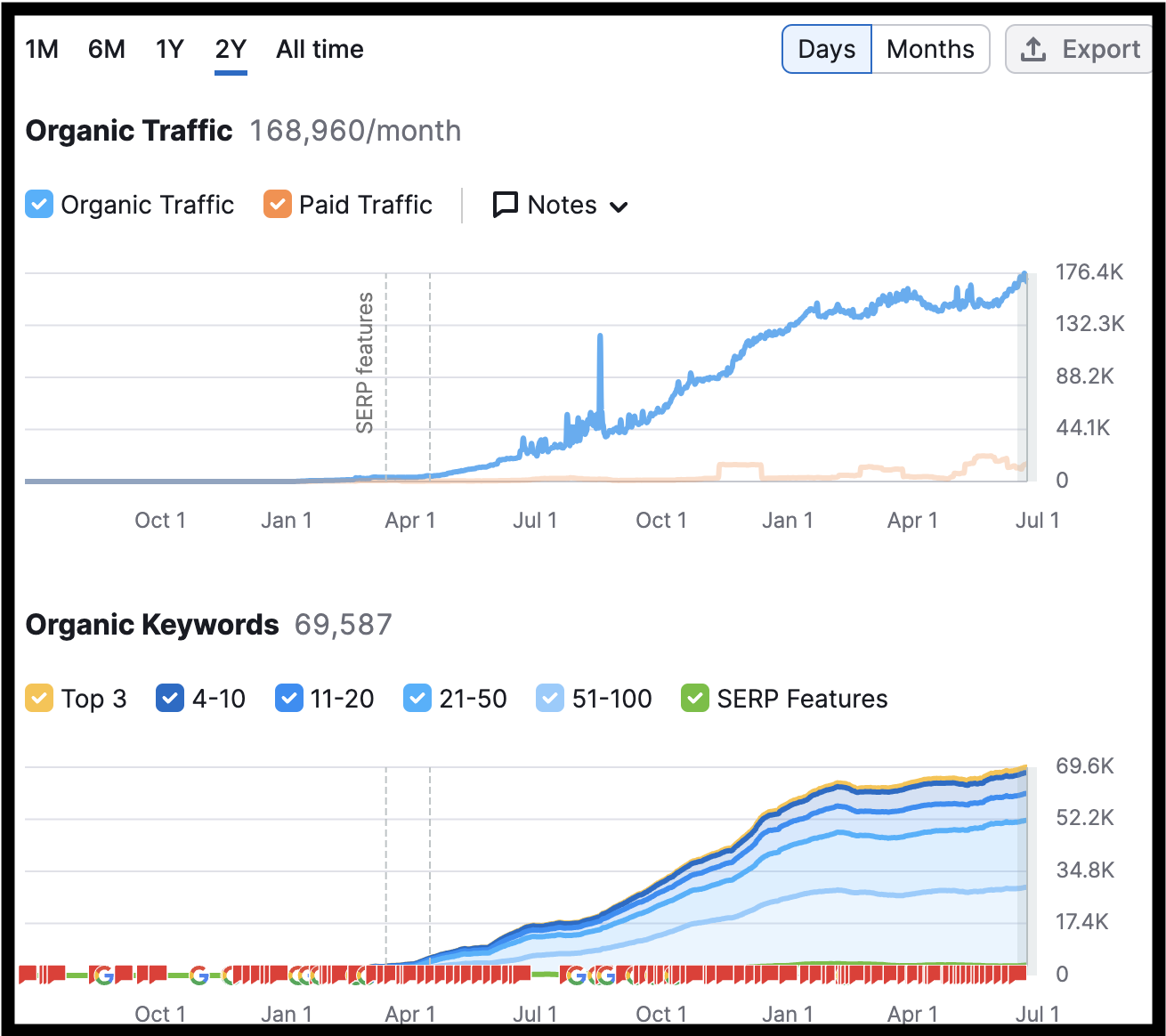
- “AI-content falling knife”: If the website’s traffic grew sharply after November 2022 and fell below 10% of the past performance within a few weeks around March 2024, it’s most probably the victim of Google’s Helpful Content Update that hit hard the websites with a high share of AI-generated content. There’s usually no way to fix the website with this pattern, even with reasonable resources invested.
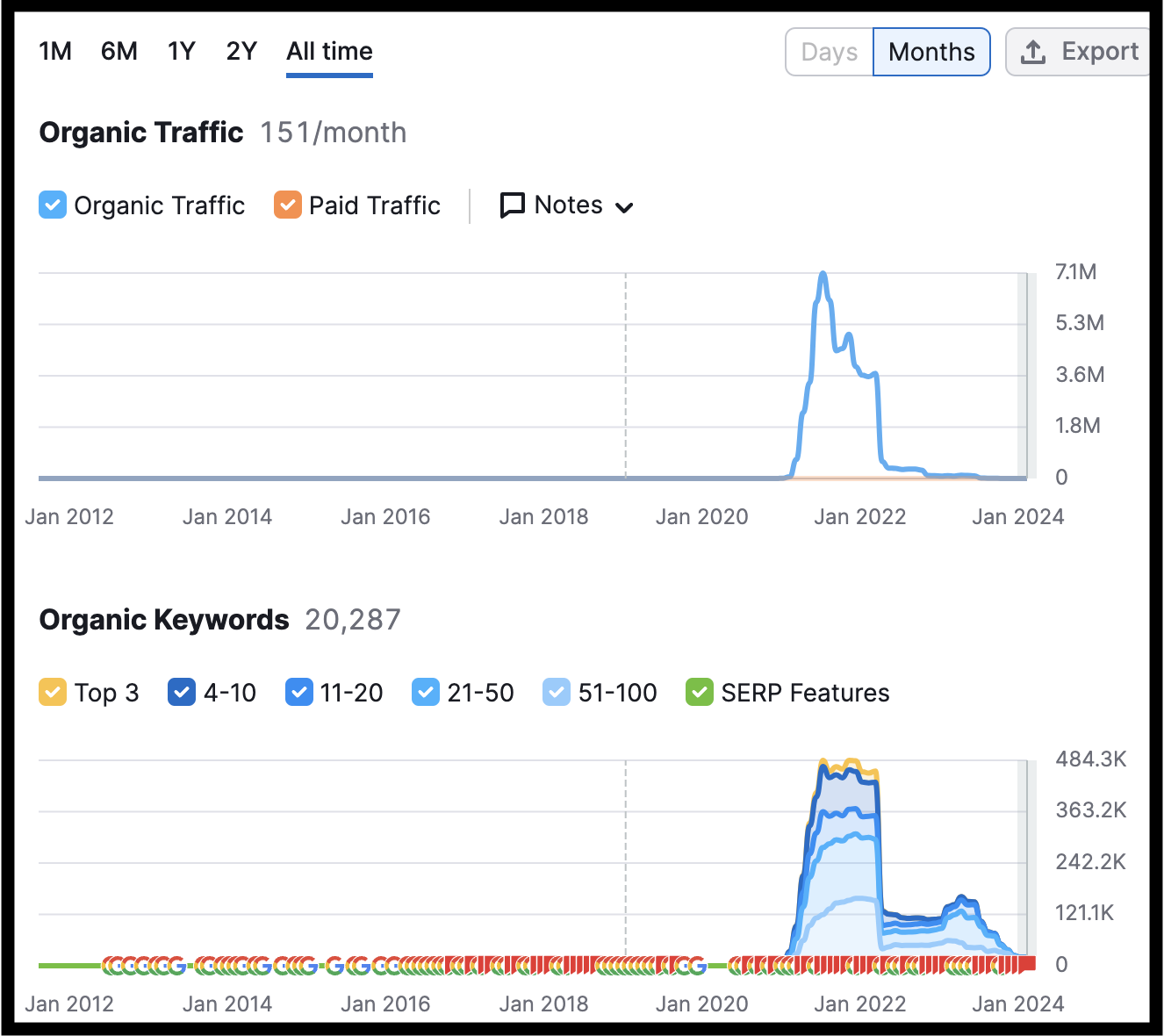
- Traffic died long ago: If a website has been underperforming for over three years, it’s much harder to fix than sites that lost performance more recently. This pattern is much better than an “AI-content falling knife,” but it will require some effort.
#3. Backlinks
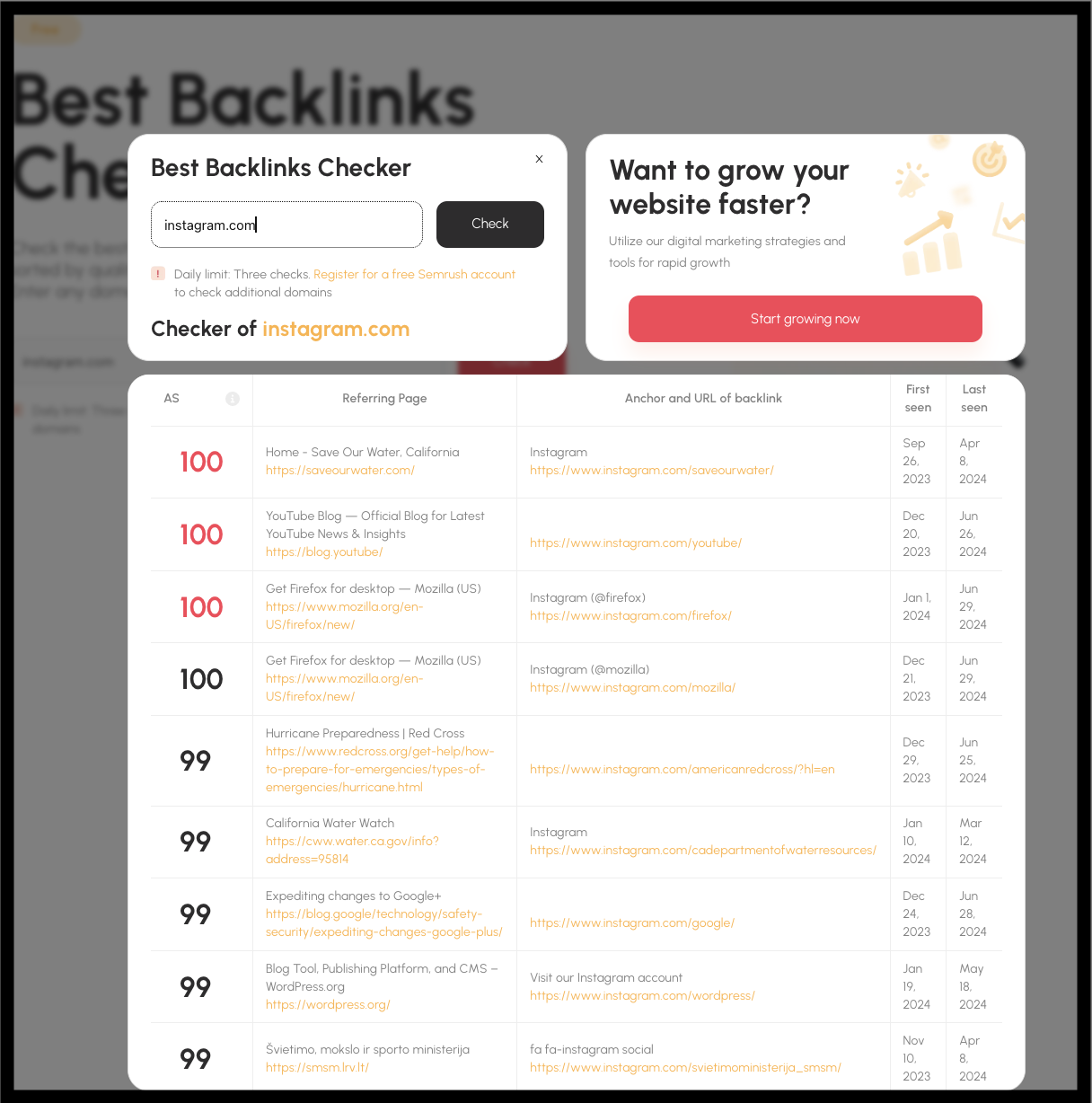
Links from other sites are one of the strongest website’s “authority” indicators for Google.
A high number of high-quality links helps a website’s content to rank higher. But getting there is not easy. Link-building takes years of effort.
Having backlinks from well-reputable sites is another great indicator of SEO success. If you see links from tier-1 media and professional websites, it’s valuable since links of this quality are rare and hard to get.
#4. Authority Score (AS)
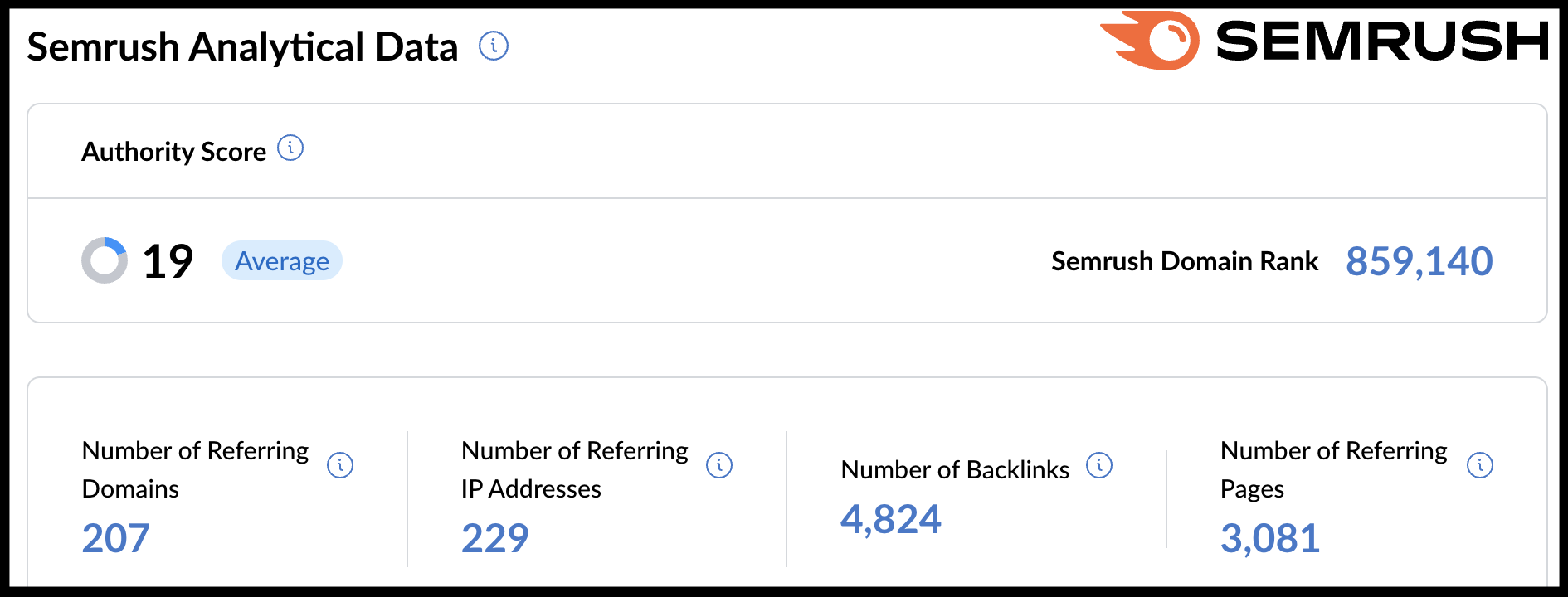
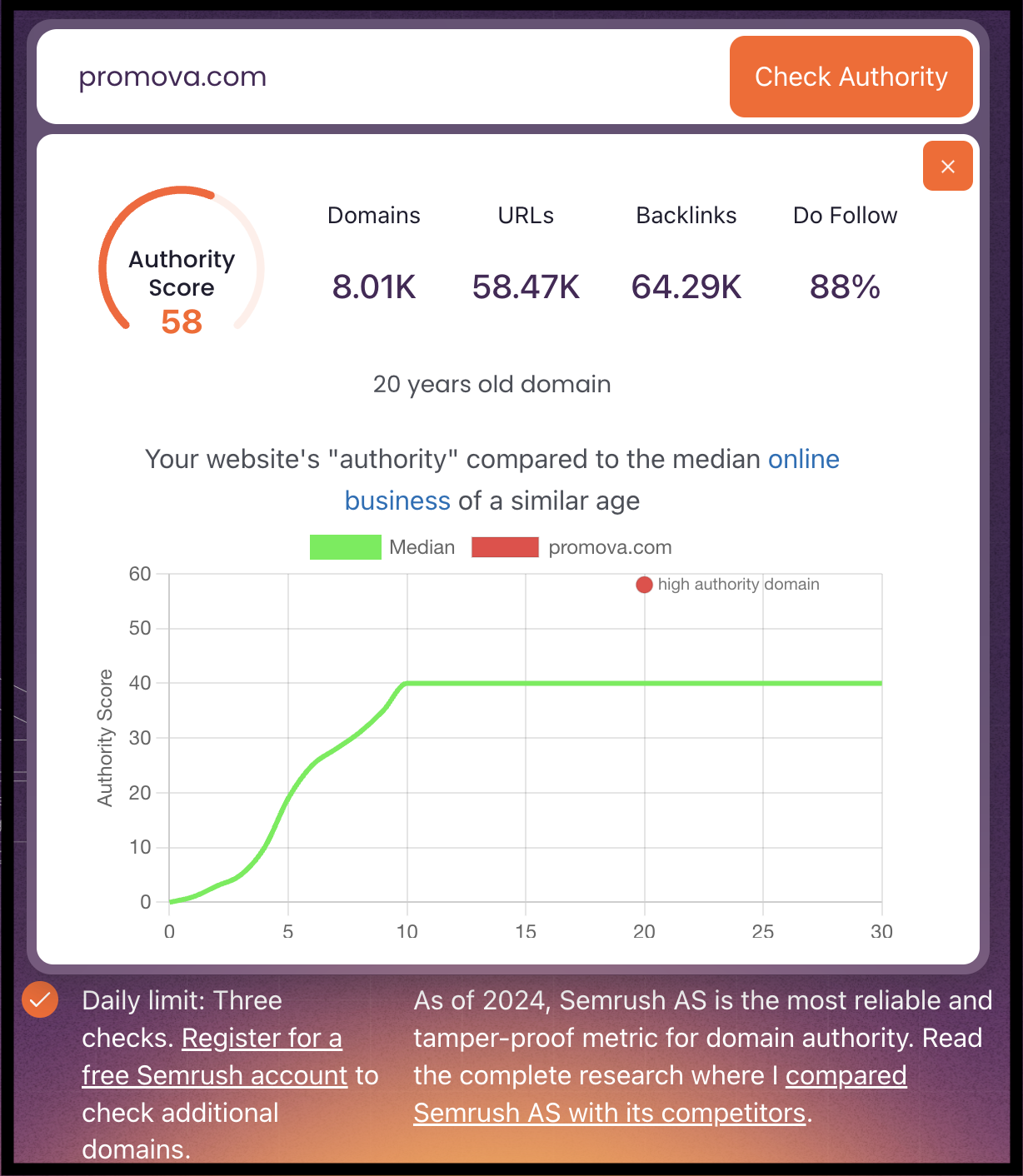
Authority Score (AS) is a proprietary metric designed by Semrush that integrates all the parameters mentioned above into a number from 0 to 100.
It helps to quickly evaluate a website’s SEO success and future potential without delving into keywords, traffic, and backlinks. This is especially useful when you need to compare several websites quickly.
Another implication of this metric is understanding how developed the website is compared to other online businesses of a similar age.
It usually makes sense to disclose the exact keywords the website ranks for and highlight the links from the most reputable sources in a marketplace listing. However, such detailed metrics can uncover the website name since top keywords usually include the branded keywords.
So, if the platform doesn’t disclose the website URL without authorization or an NDA, these details should be opened only after the user is authorized or signs the NDA.
Quickly evaluate any website’s SEO metrics here.
Does That Mean Poor SEO Performance Has No Buyers?
So, great SEO performance and metrics are analogous to passive income in investments. A website with a stable organic traffic flow and conversions that survive over time through all Google algorithm updates is a valuable asset for a new owner.
But when it comes to bad SEO performance, there is also a demand for it.
How? SEO-savvy buyers can build the content marketing vehicle over the existing business and create an additional revenue channel. These buyers will proactively look for listings with poor SEO performance.
Here is an example of the real dialogue I had with one such investor on LinkedIn:
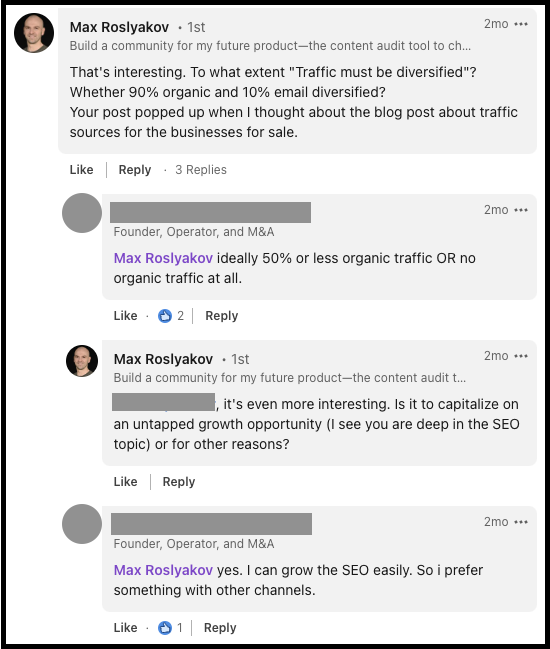
Good and bad SEO each have their buyers and demand. Let me share the best practices for integrating them into an online marketplace.
Integrating SEO Metrics
These are the approaches to showing SEO metrics used by different marketplaces.
- Show the SEO performance of every listing that contains a website. No matter how good or bad it is. Flippa and MotionInvest use this approach.
- Some other marketplaces filter the results and show the SEO performance only if the exact metric is above a certain threshold. For example, only sites above a Semrush Authority Score of 15 are shown their SEO performance. In this case, only listings with “above average” performance will contain the SEO metrics.
- If you have two versions of the listing — (i) public and (ii) with limited access — feel free to publish the Authority Score, keywords, and backlinks numbers on the publicly available page. Then, disclose the top keywords and best backlinks on the page dedicated to authorized users.
Wrapping Up
If you choose to integrate SEO metrics into the business descriptions, feel free to use the free tool my team created for online brokers and their clients. When you publish it, please refer to Semrush as a data source.
Please contact me if your marketplace has more than 50,000 annual visitors worldwide. You can qualify for a free data integration on your website.
Max Roslyakov
Founder, Xamsor